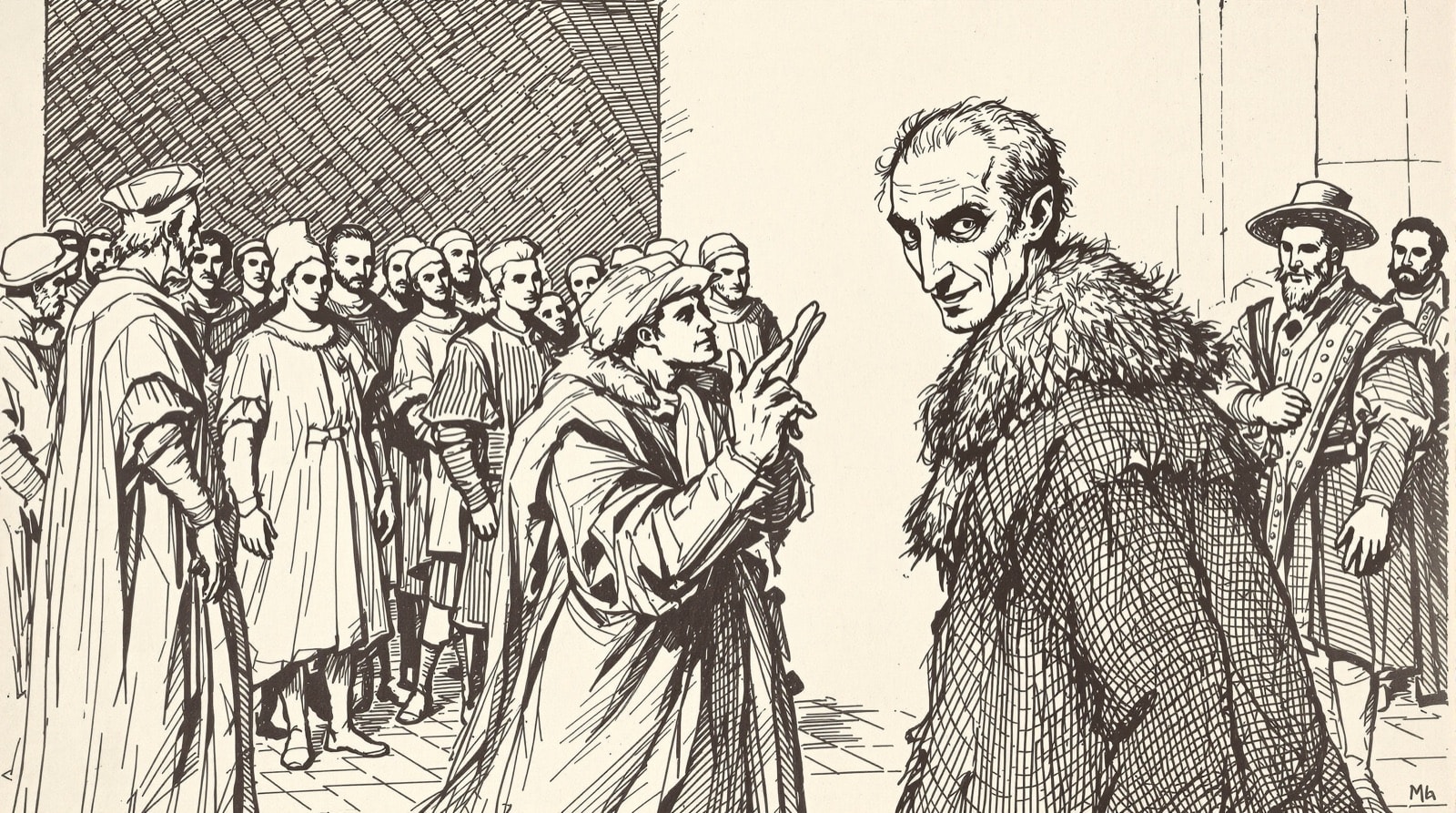
Richard III
He opens the play alone on stage, explains that he intends to be a villain, and proceeds to be one for four and a half acts with the audience's full cooperation. No other Shakespeare character is so frank so early, and none implicates the house so thoroughly. By the time the tide turns, everyone watching has been laughing with him for two hours, which is the trap the play is built to spring.
The opening
The first speech does an unusual amount of work. It sets the political situation — the wars are over, the court has gone soft — establishes a physical difference the speaker will not stop talking about, and then pivots to the flat declaration I am determined to prove a villain.
That single line has done more for the character's afterlife than any other, and it is worth noticing how carefully it is placed: it is a decision, announced in advance, not a nature confessed after the fact.
The word determined carries both senses at once — resolved, and fixed by something outside himself. The speech leaves it deliberately unclear which is meant, and the entire critical argument about the part lives in that ambiguity.
The wooing scene
In Act 1, scene 2 he courts a woman at the funeral of a man he killed, in front of the corpse, and succeeds. It is the most implausible scene in Shakespeare and the most reliably electric in performance. Nobody has ever satisfactorily explained why it works; the standard answers — she is exhausted, isolated, without protection, or genuinely overwhelmed by the sheer nerve of it — are all partial. What is undeniable is the effect on the audience, which is admiration, and the play knows it, because he turns straight to us afterwards to gloat about it.
Complicity
The soliloquies and asides are the engine. Richard treats the audience as his only confidant, sharing plans, timing and jokes, and the relationship is exclusive — no other character on stage is in on it. Then, in the second half, he stops. As the machinery closes in, the confidences dry up and he is left alone with himself on the night before Bosworth, where the intimacy that has been aimed at the audience for four acts turns inward and finds nothing that will hold together.
That withdrawal is the play's real structure, and it is why productions that cut the later soliloquy weaken the ending badly. The part is not a series of atrocities. It is a relationship with the house that is deliberately broken.
The history problem
The play is Tudor history, written under a granddaughter of the man who defeated Richard, drawing on chronicle accounts shaped by that dynasty's interests. Its Richard is a dramatic construction, and modern historians have long since detached the historical king from him — the physical portrait in particular has been complicated by the discovery and examination of his remains in Leicester in 2012, which established scoliosis and nothing resembling the play's caricature.
None of this diminishes the play, but it changes what the play is: a superb piece of political theatre about a usurper, not evidence about a reign. The Folger's free edition of the play carries an editorial introduction on its sources, and the Life and Times section of the Internet Shakespeare Editions covers the Tudor context the chronicles were written in.
The shape of the part
It is the second-longest role in the canon after Hamlet, and structurally the opposite: an actor plays Hamlet by thinking and Richard by doing. The energy is enormous in the first half and has to be spent carefully, because the last act asks for something the earlier acts do not — a man losing an argument with himself, at speed, without an audience to charm.
The other unusual demand is comic. Richard is funny, and productions that play him as straightforwardly sinister from the start find the second half unplayable, because there is nothing to reverse.
Drawing him
The one decision that matters is whether to draw the body the play talks about or the man doing the talking. A caricature of deformity reproduces the Tudor libel in ink and has been done, endlessly, for four centuries. The alternative is the address itself — a figure turned three-quarters out of the scene, speaking past everyone in it, directly to the viewer, with the rest of the court oblivious behind him. That composition is the character, and it works because it puts the reader in the position the play puts the audience: alone with him, and enjoying it.
His grandfather-in-plot, the blinded Gloucester of King Lear, is a different figure entirely despite the shared title, which trips up more readers than one might expect.