Hamlet
The longest part in the canon, the most written-about character in English literature, and the one most damaged by its own iconography. Almost everyone can produce the image — black clothes, held skull — and almost nobody who produces it can say which act it comes from. It is Act 5, after the play is effectively decided.
The size of the thing
Hamlet speaks something in the region of fifteen hundred lines, roughly a third of the play, and the play in its fullest form is the longest Shakespeare wrote — long enough that it is almost never performed uncut. Every production is therefore an edit, and the edit is an argument. Cut the Fortinbras material and you have a domestic tragedy; keep it and you have a play about a state as well as a family. Cut the players' scenes and you lose the play's account of what acting is for.
Three texts, not one
There are three substantially different early printings: a short 1603 quarto, a much longer 1604–5 quarto, and the 1623 Folio text, which is shorter than the second quarto but contains material found nowhere else. They differ in the order of scenes, in the wording of famous speeches, and in whole passages present in one and absent from another. Every modern edition is a conflation or a choice, and the differences are not trivial — the shape of the most quoted soliloquy in the language is among the things that varies.
Facsimiles of the early printings are viewable at the Internet Shakespeare Editions, and the 1623 Folio text can be read page by page in the Bodleian's digital facsimile. Ten minutes with either is enough to dislodge the idea that there is a single authoritative Hamlet.
The delay
The critical tradition is largely a set of competing explanations for why a man who knows what he must do takes four acts to do it. He is too thoughtful; he is grieving; he doubts the ghost; he is playing for evidence; he is depressed; the play needs him to be. Each reading produces a different performance and each has been fashionable.
What is worth noticing is that the play supplies material for all of them and endorses none. Hamlet himself proposes several explanations, at length, and discards them. A character who theorises about his own inaction and gets it wrong is a stranger and more modern invention than any of the tidy readings, and it is the likeliest reason the part has never worn out.
What the ghost changes
The play opens on soldiers, not on the prince — a full scene of cold, frightened men on a platform before anyone at court speaks. That order matters. By the time Hamlet appears, the audience already knows something is wrong with the state, so his mourning reads as perception rather than temperament. Productions that trim the opening to reach the prince faster reliably weaken the whole first movement.
The graveyard
The skull belongs to Yorick, a court jester Hamlet knew as a child, and the scene is not a meditation on death in the abstract. It is specific, physical and slightly disgusting — a man handling the remains of someone who carried him on his back — and it is funny before it is solemn, because the gravediggers are the best comic double act in the tragedies.
The reason the image escaped the scene and became the play is the same reason discussed on the quotations page: a single legible object beats a complicated argument every time. A prince holding a skull can be drawn in six lines and recognised at a glance. Four acts of a man reasoning himself in circles cannot be drawn at all. The illustration tradition has been choosing the skull for three hundred years for entirely practical reasons.
Drawing him
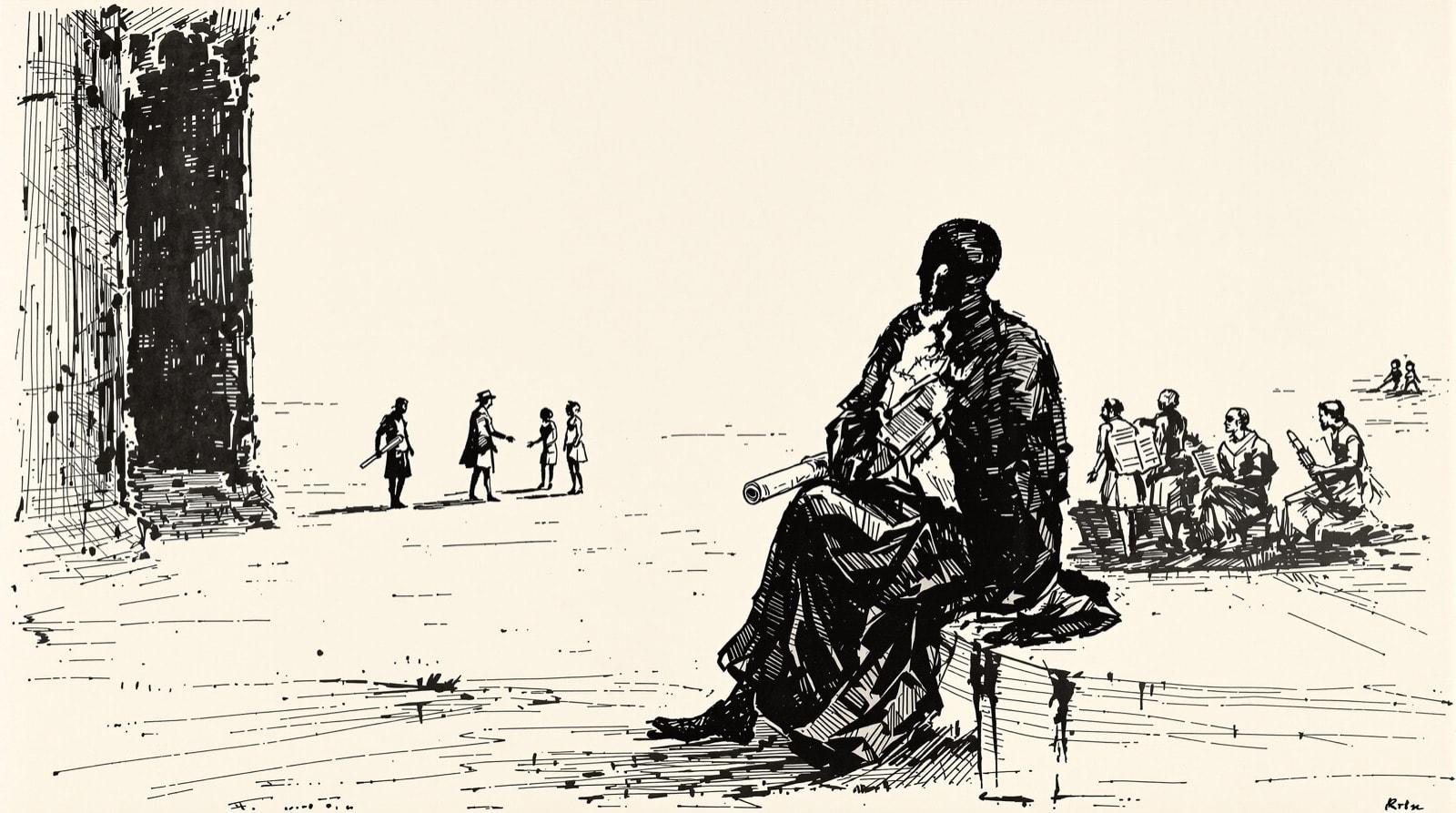
Refusing the skull is a fair discipline. The alternatives are better anyway: Hamlet watching the players and seeing an actor weep for a woman dead three thousand years; Hamlet with the recorder, inviting Guildenstern to play on him; Hamlet reading, and answering a question about the book with Words, words, words.
Any of those puts the intelligence on the page instead of the prop.
Around him
Gertrude, Rosencrantz and Guildenstern are treated separately, as is the play's habit of putting substantial weight on very small parts. Ophelia's scenes reward the same attention: her mad scenes are made of fragments of real songs, which an audience in 1600 would have recognised and finished in their heads.