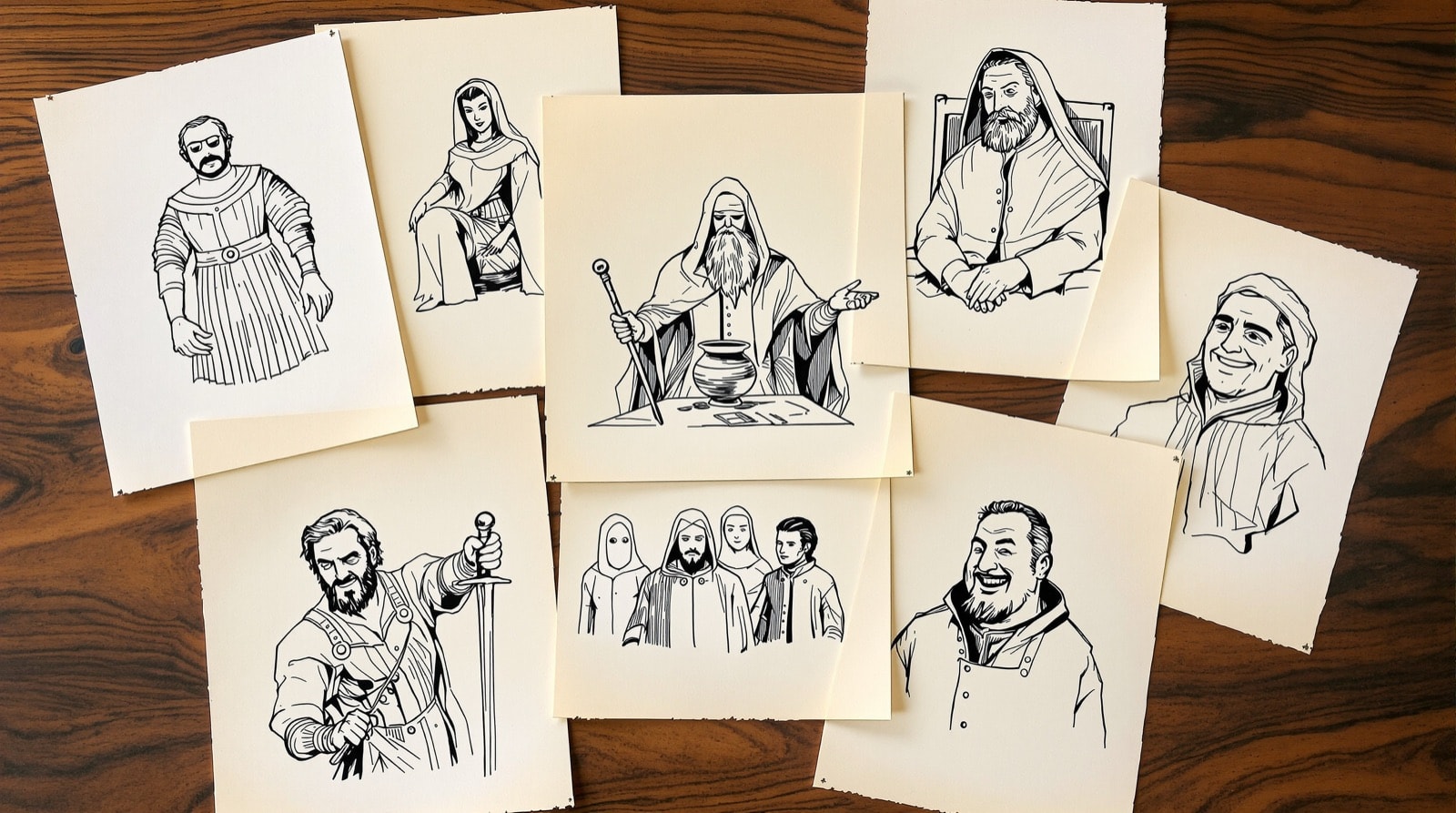
Additional Characters
Every company knows that the parts an audience waits for are not always the title parts. Below are the second-rank figures with the strongest afterlives — the ones who get drawn, quoted and argued about out of all proportion to their line counts, and the specific thing in each that makes them stick.
Malvolio — Twelfth Night
The steward of Olivia's household is gulled by a forged letter into believing his mistress loves him, appears cross-gartered and grinning in yellow stockings, is shut in a dark room as a madman, and exits the comedy on the line I'll be revenged on the whole pack of you.
That exit is the reason he endures. It is the moment a comedy admits it has been cruel, and productions since the nineteenth century have increasingly played the last act as an accusation rather than a punchline.
Malvolio is also the great test case for a portraitist. The yellow stockings are irresistible and slightly dishonest: draw them and you have drawn the joke, not the man. The alternative — the steward before the letter, upright, self-satisfied, absolutely certain of his own dignity — is harder and truer, because the whole trap depends on that dignity being real.
Gertrude — Hamlet
Gertrude has fewer than two hundred lines and is the pivot of the play's central accusation. What she knew, and when, is deliberately withheld: the text never confirms complicity in the murder, and it never clears her either. Her most famous line is about someone else — The lady doth protest too much, methinks
— and is now almost always quoted with the opposite meaning to the one it carries in the scene, where protest means to promise or vow, not to object.
She gets one unambiguous act of authorship: the drinking of the poisoned cup in Act 5, against an explicit instruction not to. Whether that is accident, defiance or knowledge is the single largest interpretive lever in the part, and any drawing of her has to decide.
Gloucester — King Lear
The play's second plot belongs to a father who trusts the wrong son, is blinded on stage in the most violent scene Shakespeare wrote, and then walks toward Dover intending to die. His arc is Lear's rendered literal: the metaphorical failure to see becomes an actual one, and the recognition comes only after the eyes are gone. I stumbled when I saw,
he says, which is the whole tragedy in five words.
The blinding is the scene productions cannot avoid and rarely handle the same way twice. It is also, for anyone drawing him, the moment to consider not showing — Gloucester at the imagined cliff edge, guided by the son he disowned, contains everything and requires no blood.
The Weird Sisters — Macbeth
They appear in four scenes and dominate the play's reputation entirely. The text is careful never to make them straightforward prophets: what they say is true and useless, formally accurate and practically catastrophic, and Macbeth supplies every disastrous interpretation himself. The famous chant — Double, double toil and trouble
— is spoken over a cauldron in Act 4, a scene widely thought to contain later interpolated material, which has not dented its grip on the popular imagination in the slightest.
Their staging history is a history of embarrassment and reinvention: eighteenth-century productions played them broadly comic, Victorian ones spectacular, twentieth-century ones frequently silent, doubled or multiplied. The word weird in their name is the older wyrd, meaning fate — a fact that changes how the whole play reads and that almost no modern audience hears.
Rosencrantz and Guildenstern — Hamlet
Two courtiers, functionally interchangeable, summoned to spy on a friend and dispatched offstage to a death reported in a single line. Shakespeare never distinguishes them; the joke that nobody can tell them apart is written into the text, where the king and queen correct each other's greeting on their first entrance. They are the play's demonstration that a tragedy has a periphery, and that the periphery is where most people actually live.
Their afterlife is unusually large for parts this small, and the pairing is a gift to an illustrator precisely because it must be drawn as a unit — two figures, one silhouette, no way to tell which is which.
Mercutio — Romeo and Juliet
He is the fastest talker in the canon and he dies in Act 3, taking the comedy of the play out with him. The Queen Mab speech is a set piece that can be played as wit, as mania or as a man frightening himself; the death is a joke that turns out to be true — Ay, ay, a scratch, a scratch
— followed by the curse on both houses that the rest of the play proceeds to fulfil.
Nick Bottom — A Midsummer Night's Dream
A weaver, an amateur actor of monumental confidence, and the only mortal in the play who touches the fairy world and survives it happily. Given an ass's head and the love of a queen, he takes both entirely in his stride. His waking speech — an attempt to describe a dream that keeps outrunning his vocabulary — is one of the tenderest passages Shakespeare gave a comic part, and it is why the character has never been merely a buffoon. More on him and his company on the Dream page.
Reading further
Line counts, scene divisions and variant readings for all of these parts can be checked in the free edited texts published by the Folger Shakespeare Library, and the textual history behind them — quarto against folio — is set out accessibly by the Internet Shakespeare Editions.