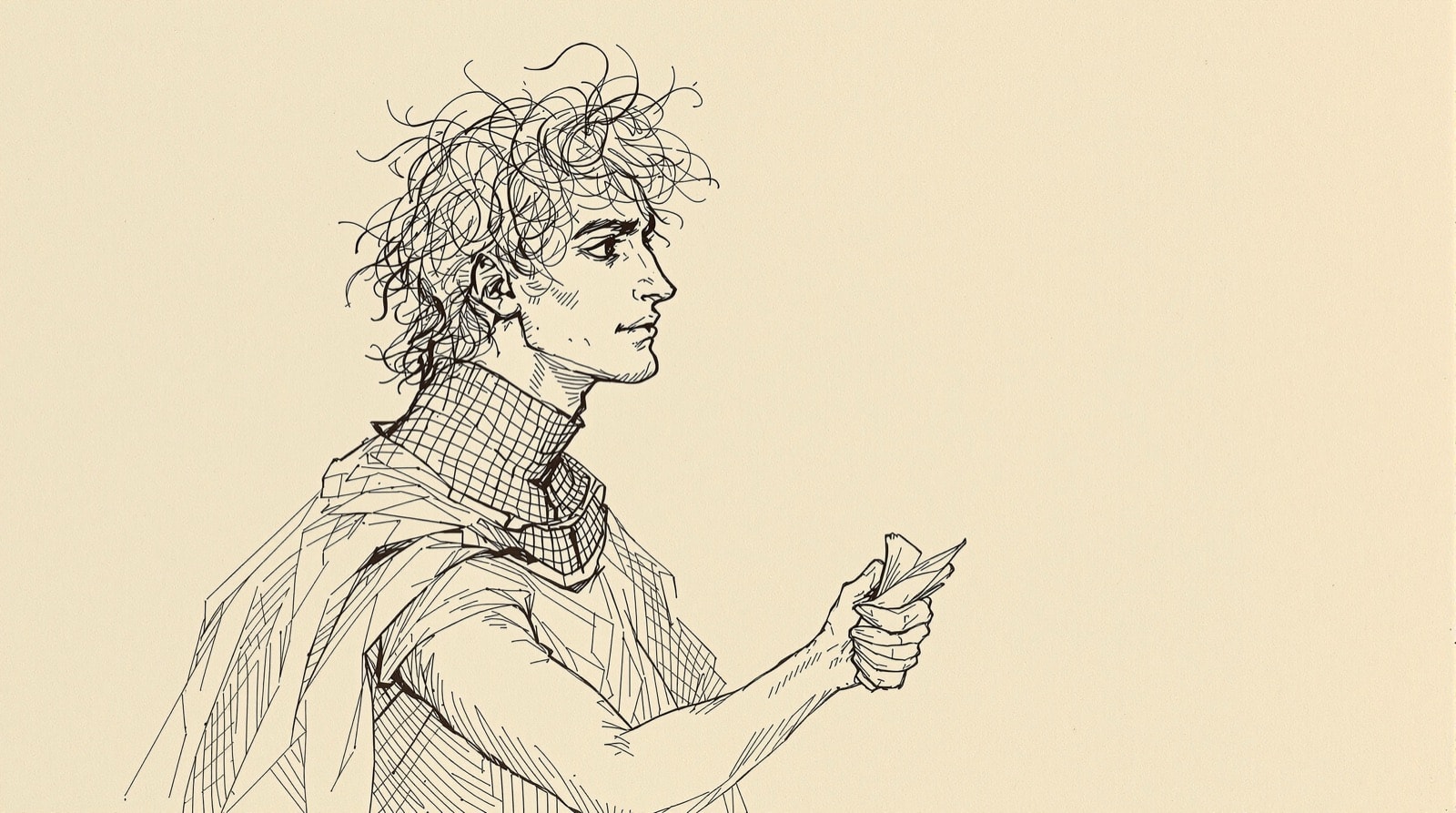
Hotspur
Harry Percy is the most attractive loser in the histories, and the part is a masterclass in building a character out of tempo. He talks faster than anyone around him, interrupts constantly, cannot sit through a meeting, and dies at the hands of a prince he has spent four acts describing as a wastrel. He gets roughly six hundred lines and has never been forgotten.
Where he sits in the play
Henry IV, Part 1 is built on a rhyme between two young men. Prince Hal is the king's son and appears to be wasting himself in a tavern; Hotspur is another man's son and is everything the king wishes his own boy were. The play states the comparison in its first scene, with the king openly wishing the two had been exchanged in the cradle, and then spends five acts dismantling it. By Shrewsbury the terms have reversed: the prince has become formidable and Hotspur has become reckless, and the play's judgement is delivered by a battlefield rather than a speech.
The speed
What makes the part singular is rhythmic. Hotspur's verse is full of run-on lines, self-interruption and lists that outgrow their sentences; he starts an anecdote about a courtier at the battlefield's edge and cannot stop himself finishing it, in front of the king, at length, having been asked a direct question about prisoners. His wife's complaint about him is that he does not sleep and will not say why. Read aloud, the lines resist being slowed down: the character is written into the metre before he is written into the plot.
The famous flight of it is the honour speech in Act 1, scene 3 — the leap to pluck bright honour from the pale-faced moon
— which is thrilling and also, on inspection, entirely unmoored from anything achievable. That double quality runs through the part. He is right about the king's ingratitude and wrong about almost every practical decision that follows from it.
The history he departs from
The historical Sir Henry Percy was a generation older than Prince Hal — closer in age to the king than to the king's son — and was a soldier of long standing on the Scottish border when the rebellion came. Shakespeare compressed the ages so the two could be set against each other as contemporaries. It is one of the most consequential adjustments in the histories, and the plays are structurally dependent on it: without it there is no rivalry, only a revolt.
This kind of compression is normal in the history plays and worth remembering whenever they are read as record. The Life and Times section of the Internet Shakespeare Editions sets out the chronicle sources Shakespeare worked from and the political world the plays were written into.
The death, and Falstaff
Hotspur is killed by Hal in single combat and dies mid-sentence, the line finished for him by the man who has just killed him — a small, devastating piece of stagecraft. Then Falstaff, who has been playing dead nearby, gets up, wounds the corpse and carries it off to claim the credit. The play puts its most idealistic character and its most cynical one on the same patch of ground within thirty lines, and refuses to comment.
That juxtaposition is why Part 1 holds up better than almost any other history. It is not a play about whether honour is worth dying for. It is a play that shows a man dying for it and a man laughing at it and declines to arbitrate.
Drawing him
The obvious image is armour, and the obvious image is wrong. Hotspur in armour is any knight in any history. What is particular to him happens in rooms: reading a letter and arguing with its absent author, refusing to hand over prisoners, mocking Glendower's mysticism to his face while the man is standing there, being teased by his wife and having no answer. A portrait that catches the impatience — half-turned, already leaving, still talking — has more of the character in it than any battlefield.
The related problem is age. Centuries of casting have made him a young firebrand because the play needs the rivalry to read as generational. That is Shakespeare's design and there is nothing wrong with honouring it, but it is worth knowing it is a design, not a fact.
Elsewhere in the canon
He is discussed in absentia through Henry IV, Part 2, where his widow's speech about him is one of the finest pieces of elegy in the histories and effectively completes the portrait from outside. Anyone who only knows the character from Part 1 is missing the epitaph.