A Midsummer Night's Dream
Three plots, three worlds and one wood that scrambles all of them. It is the most performed comedy in the canon, frequently by people who have not noticed how strange it is: a play in which a queen is drugged into loving a man with an animal's head, and everyone agrees afterwards that nothing much happened.
The structure
A court plot frames everything: a duke's wedding is coming, and a girl is ordered to marry a man she does not want. Two pairs of lovers flee into the wood and are rearranged there by a drug applied to the wrong eyes. A quarrelling fairy king and queen are already in the wood, fighting over a child. And six tradesmen have come out to rehearse a play in secret, because the wood is the only place nobody will overhear them.
The four strands never fully mix — the lovers never learn what happened, the mechanicals never learn who they met — and the play ends with everyone returned to the city, married, watching a terrible amateur tragedy and heckling it. That last act is the whole reason the play holds: after a night of genuine disorder, the resolution is not an explanation, only a wedding entertainment about lovers who die.
Bottom
Nick Bottom is a weaver, an amateur actor of monumental self-confidence, and the play's warmest invention. In rehearsal he wants to play every part including the lion and the wall; given an ass's head and the love of a fairy queen, he accepts both with complete equanimity and mainly wants his ears scratched. He is never frightened, never humiliated in his own estimation, and never told what happened to him.
His waking speech is the finest thing in the play. He gropes for what he dreamed, tangles his own senses in the reaching — eyes hearing, ears seeing — and gives up on describing it, deciding instead to have a ballad written about it. It is a joke about a man out of his depth and simultaneously the play's most serious statement about what an experience like that is worth, and it can be played either way or, best, both.
The mechanicals
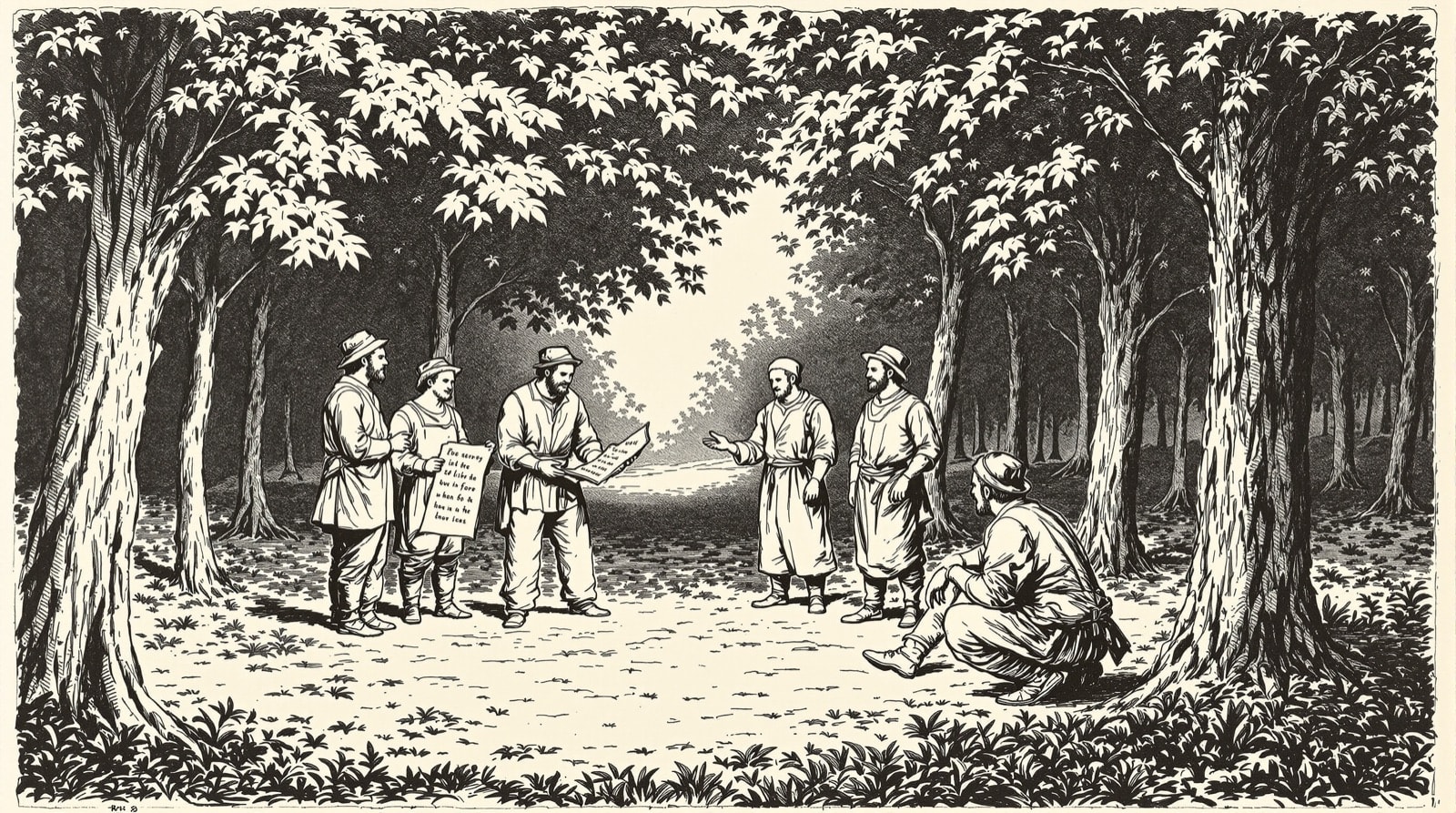
Quince, Snug, Flute, Snout and Starveling are a portrait of amateur theatre so exact that four hundred years have not dated it: the anxious director, the man who needs the lion's part written down as harmless, the young man who does not want to play the woman, the endless worry about frightening the ladies. Their Pyramus and Thisbe is a genuine hazard for a production — it is written to be bad, so it must be performed with total commitment, and companies that play it as knowing parody kill it instantly.
The play-within-the-play is also, quietly, the same story as Romeo and Juliet, told as farce, in a comedy written around the same period. Shakespeare stages the tragic plot as a joke and lets the audience decide what to do with that.
The edge
Twentieth-century criticism and staging drew out the darker material that Victorian productions had smoothed over: the opening threat of death or a nunnery, the fairies' quarrel as something with weather in it and consequences for the harvest, Oberon's use of the drug on Titania as an act of coercion, and the fact that Demetrius is still under the flower's influence at the final curtain. None of that is imported. It is in the text, and productions that ignore it produce a prettier and much thinner play.
The wood
Everything happens at night, outdoors, and originally in an open-air playhouse in the afternoon — the darkness entirely conjured by language, in daylight, in front of a standing audience. Anyone interested in how much of Shakespeare's night writing is a practical response to that constraint can see the conditions at the reconstructed Shakespeare's Globe, where the plays are still staged in daylight.
Drawing it
The ass's head is the emblem and it is a real trap, because it is funny on the page and the character is not a joke. The drawings that hold up give Bottom his dignity: sitting comfortably, being attended to, entirely at ease in a situation that would destroy anyone else in the cast. The alternative subject is the rehearsal — six working men in daylight clothes standing in a circle in a wood, arguing about a script — which has no magic in it at all and is somehow the most magical thing in the play.
More on the second-rank parts, including Bottom's neighbours in the canon, on the additional characters page.