Julius Caesar
The title character has around one hundred and fifty lines and is dead by the middle of Act 3. What follows is not an aftermath but the actual play: two speeches, a riot, a proscription list and a civil war, all set in motion by men who believed they had finished the job when they finished the killing.
Brutus, and the problem of the honourable conspirator
Brutus is the part the play is built around and the hardest to cast, because he must be genuinely admirable and consistently wrong. He joins the conspiracy on principle rather than grievance, refuses to bind the conspirators with an oath because honest men need none, refuses to kill Antony because that would make it butchery rather than sacrifice, and then insists on letting Antony speak at the funeral. Each decision is honourable. Each is catastrophic. Together they lose the republic.
His self-examination in the orchard before the assassination is the play's ethical centre: he can find nothing in Caesar's actual conduct to justify the murder, so he argues from what Caesar might become. The reasoning is explicitly hypothetical, and Brutus knows it. Shakespeare puts the weakest link in the argument in the mouth of the most scrupulous man in the play, and lets it stand.
The two speeches
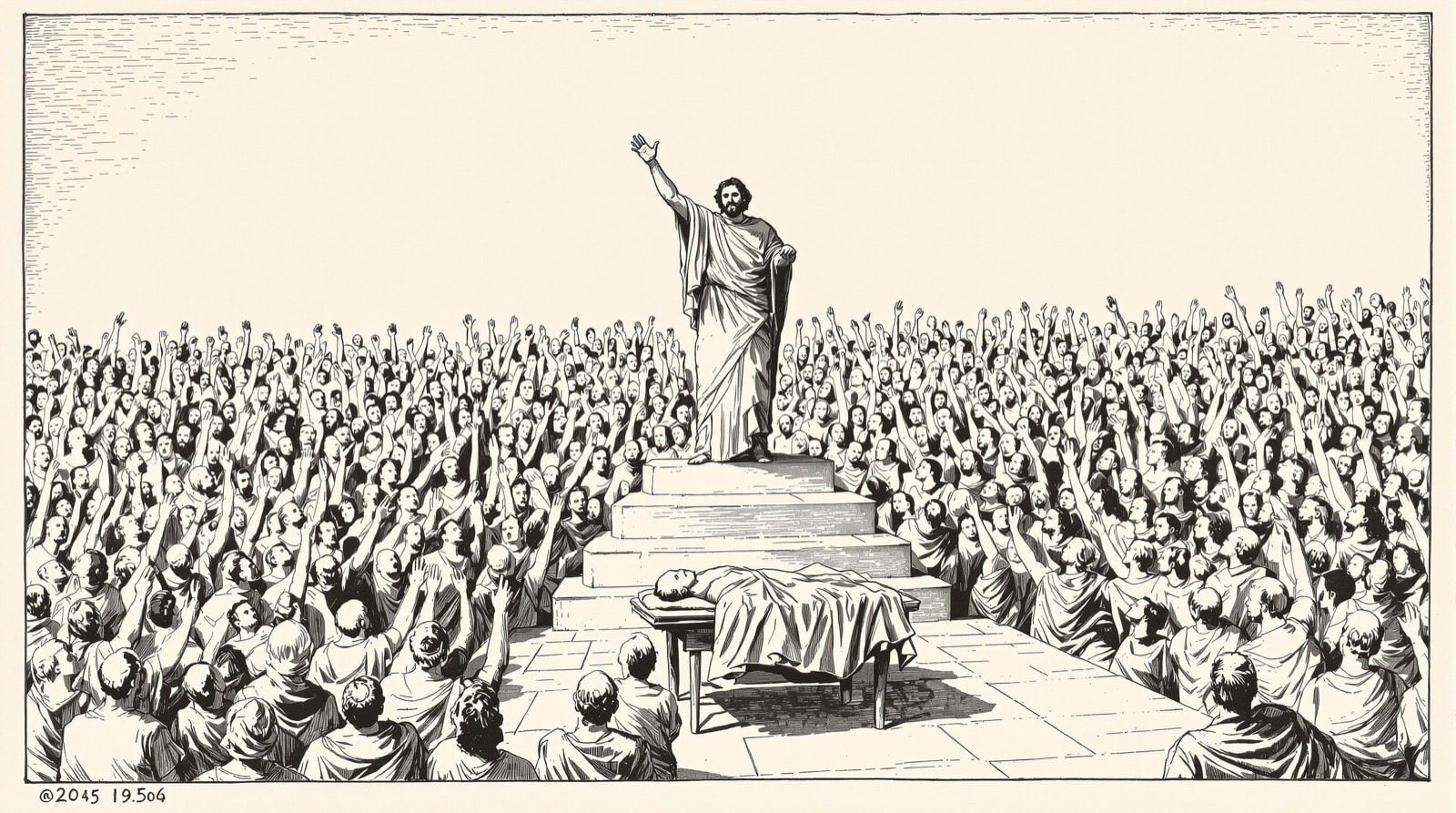
The funeral scene is the most efficient demonstration of rhetoric in English drama, largely because both speakers are good. Brutus speaks in prose, plainly, appeals to reason and republican principle, and wins the crowd. Antony follows with verse, an apparent concession, a refrain that curdles by repetition, physical evidence, a will he pretends to withhold, and a corpse he uncovers at the right moment. He never contradicts Brutus directly; he simply reframes every point until the crowd does the contradicting for him.
What makes it more than a set piece is the ending. The mob leaves the forum and murders a poet for having the same name as a conspirator, and knows it is the wrong man, and does it anyway. That scene is short, frequently cut, and the most honest thing in the play.
The crowd
Rome's citizens open the play being told off by a tribune for cheering the man who beat the leader they were cheering last month, and close it having been played by everyone. Shakespeare's treatment of them is genuinely double: contemptuous of their volatility, and completely clear that the volatility is manufactured by people who understand exactly what they are doing. Both readings are supported; productions have leaned each way according to the politics of the decade.
Sources and liberties
The play draws closely on Plutarch's Lives in Thomas North's English translation, at times almost transcribing it — the funeral, the omens, the quarrel in the tent. What Shakespeare adds is the interior argument, which Plutarch does not supply. Comparing a page of North with the corresponding scene is one of the clearest available demonstrations of what a dramatist actually does with a source, and the Internet Shakespeare Editions makes the source material readily available alongside the text.
The famous anachronism — a striking clock in ancient Rome — is real and is not carelessness worth much comment; the Elizabethan stage habitually dressed antiquity in its own clothes, and the audience was not being asked to time-travel.
The quarrel scene
Act 4 gives Brutus and Cassius a long argument in a tent that has nothing to do with plot and is the reason actors want to be in the play. It is a scene about two exhausted men who have done something irreversible together, saying unforgivable things and then not meaning them. The news of Portia's death arrives in the middle of it, twice, in two different textual traditions — one of the odder editorial cruxes in the canon.
Drawing them
The assassination is the expected image and the least interesting: a crowd of men with knives is a crowd of men with knives. The scene that draws well is the forum — one figure raised above a mass of faces, the body on the boards behind him, half-covered. It contains the whole play, and the reason it works is that the crowd's faces are the subject. Rhetoric has no visible form; the effect of rhetoric does.