The Festival Circuit
For a large part of the English-speaking world, Shakespeare is a summer activity performed outdoors by a company that will do three or four plays in rotation and strike the set in September. That model is roughly a century old in its modern form, and it has quietly shaped how the plays are staged, cast and understood.
Where it came from
The idea of a seasonal festival devoted to a body of classical work is a nineteenth-century European import, and it landed in the English-speaking theatre in the twentieth. Stratford-upon-Avon has held Shakespeare celebrations in various forms since the eighteenth century, and permanent festival theatres followed in Britain, Canada and the United States through the middle decades of the twentieth century. The Oregon Shakespeare Festival, founded in Ashland in the 1930s, is among the oldest and largest of the American examples and has run a long repertory season for decades.
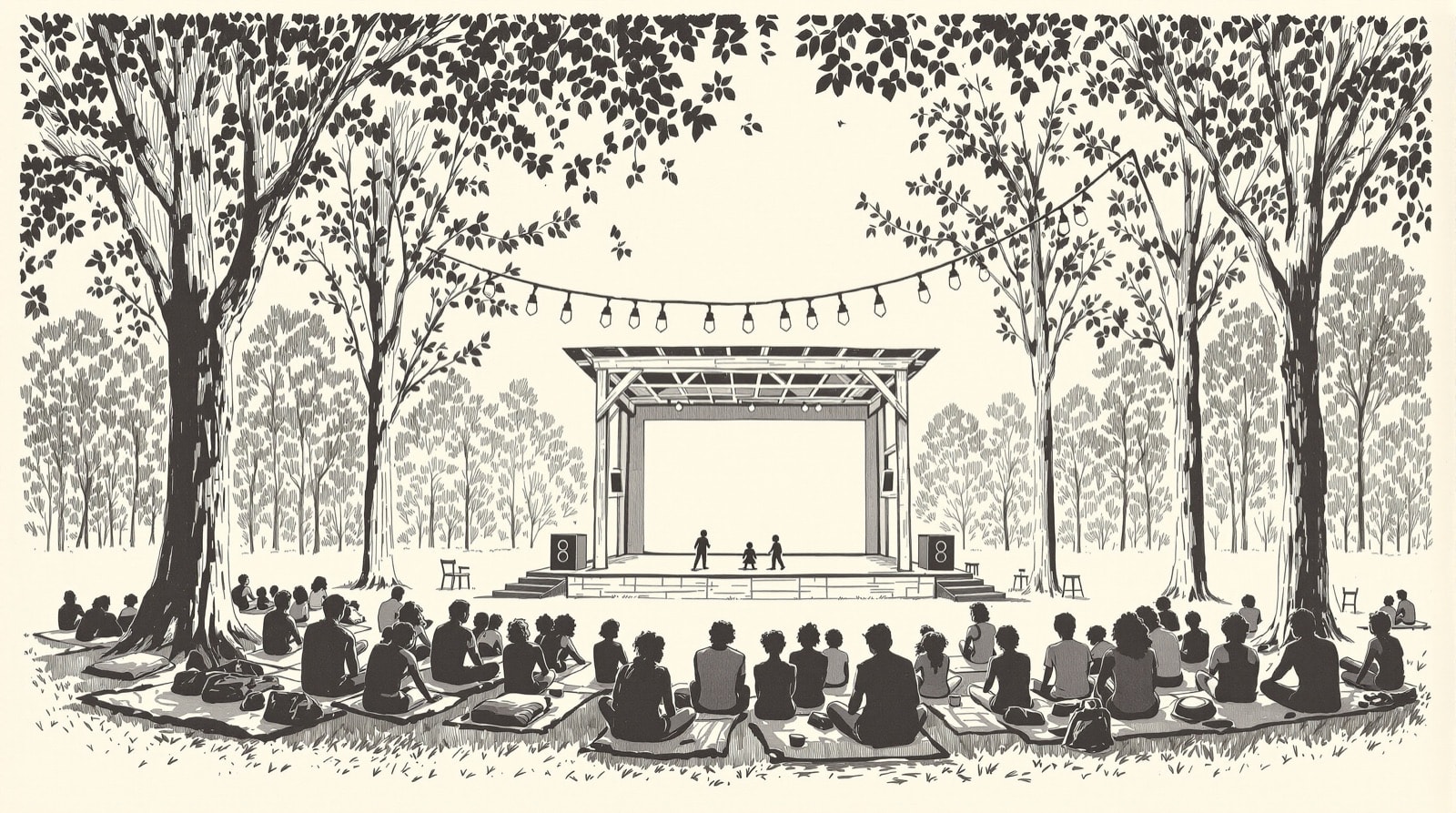
What spread faster than the permanent institutions was the amateur and semi-professional summer festival: a park, a temporary stage, a company assembled for a season, admission free or nearly free. There are hundreds, and they collectively account for far more performances of these plays than the major houses do.
What repertory does
Running several plays in rotation with one company has consequences that show up on stage.
- Casting across plays. An actor may be Rosalind on Tuesday and Lady Macbeth on Wednesday, and the season is cast so that the company balances rather than each play individually. This is why festival casting sometimes looks eccentric in isolation.
- Doubling is normal. Small parts are shared out, and a company of fourteen will cover a play written for twenty-five. Shakespeare's own company doubled constantly, and the texts are built to allow it.
- Shared design. Sets must strike and restore quickly, which pushes design toward the adaptable and the architectural — a platform, a gallery, some doors — which happens to be much closer to the original staging than a naturalistic box.
Daylight and weather
Outdoor performance in the evening restores something the plays were written for and modern indoor theatre removes: a lit audience. When the house can see itself, direct address stops being a convention and becomes a conversation. Soliloquies land differently; asides genuinely work; a comic actor can find and hold an individual face. This is the condition reproduced deliberately at the reconstructed Shakespeare's Globe, and anyone who has seen the same play indoors and out will recognise the difference immediately.
Weather is the other half of it. Wind takes verse away, rain stops nothing, aircraft arrive during the quiet passages, and the light changes across the performance so that a play beginning in daylight ends in the dark. Companies learn to use it — A Midsummer Night's Dream played outdoors as the actual light fails is a effect no lighting board can buy.
What it does to the plays
Outdoor festival conditions favour the plays that were built for a big, mixed, partly distracted audience: the comedies, the histories with battles, anything with music, anything with a clown. The quiet interior tragedies are harder — a great deal of Macbeth happens in whispers — and companies that programme them outdoors usually pull the staging toward ritual and scale to compensate.
The circuit also shapes what audiences expect a Shakespeare production to look like: broad, fast, physically clear, aimed at people some of whom are on a picnic blanket a hundred feet away. That is not a debasement. It is very close to the original commercial proposition.
Going
Programmes and season details are published by the companies themselves; the links page lists several of the long-established houses. For anyone attending with children or with a first-timer, the reliable advice is unchanged: read a two-paragraph synopsis beforehand, sit close enough to see faces, and choose a comedy. The plots are not the point and never were — the audiences these plays were written for already knew the stories.